

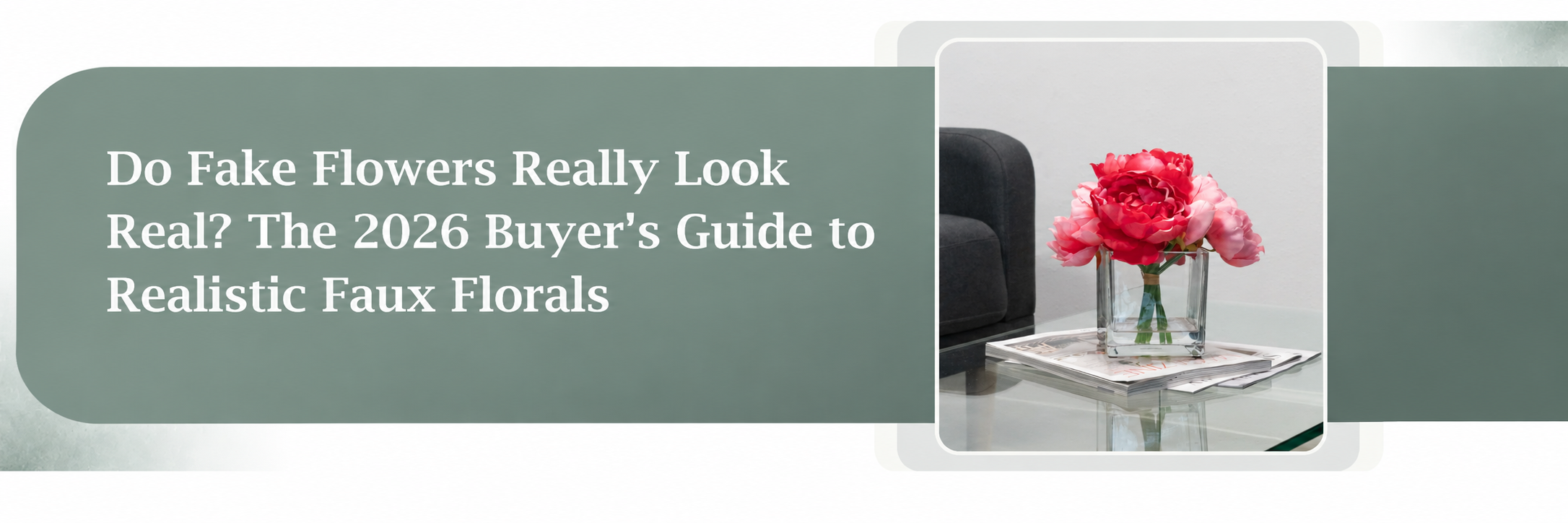
Do Fake Flowers Really Look Real? The 2026 Buyer's Guide to Realistic Faux Florals
Key Takeaways
- Tall artificial plants offer the beauty and calming effect of natural greenery without the need for watering, sunlight, or pruning, making them ideal for any room or lighting condition.
Why this matters in 2026
It's the question every faux floral buyer asks before checkout: Are these going to look like a craft store afterthought, or actual flowers? Twenty years ago, that hesitation was justified — the typical fake flower was a chunk of plastic with a wire stem and a single flat color. Today, the gap between premium artificial flowers and fresh blooms has narrowed to the point where wedding florists, interior designers, and high-end hotels routinely mix the two without disclosure.
That said, not every fake flower has caught up. The difference between a $12 stem that fools no one and an $80 arrangement people genuinely mistake for real comes down to four specific things: the material, the petal construction, the stem build, and how it's styled in your home. We'll walk through each — and if you want to skip ahead to the products that demonstrate the principles, our floral collection is organized so you can filter directly to the real-touch options.
The 5 Things That Make a Fake Flower Look Real
-
Petal material that catches light correctly. Real petals are slightly translucent and matte; they catch light unevenly. The most realistic fake flowers use either real-touch latex (a polyurethane coating over a fabric or foam core) or high-grade silk that's been hand-dyed with color variation. Plastic-finished petals reflect light too uniformly and read as artificial immediately.
-
Hand-painted color variation. Real petals are never a single uniform color. The lifelike ones have darker veins, lighter edges, and subtle gradients between center and tip. Mass-produced fake flowers print one flat color across the whole petal. Premium ones are hand-painted, with shading that mirrors how the bloom would have grown.
-
Layered, three-dimensional petal construction. Look at a real rose: dozens of petals, each at a slightly different angle, layered from the center outward. Cheap fake flowers compress this into five to eight flat petals glued to a foam core. Realistic faux roses use 20+ individually attached petals with progressive sizing — small at the center, full at the perimeter.
-
Wire stems wrapped in cloth or floral tape. A bare green plastic stem is the single most common giveaway. Real-touch and premium silk flowers use steel wire wrapped in floral tape or cloth, with realistic stem texture and bend-ability that lets you arrange them naturally. The wire also means the stem can be cut to length without snapping.
-
Imperfection. This is the counter-intuitive one. Real flowers aren't perfectly symmetrical. The most realistic fakes deliberately include slightly curled petals, varied bud sizes within an arrangement, and the occasional brown edge or freckle. Identical, flawless blooms always read as artificial — nature doesn't make matched sets.
Material Guide: Silk vs. Real-Touch vs. PE — The Honest Breakdown
Now the technical breakdown. The faux floral industry uses four primary materials, and the words on the packaging don't always describe what's actually inside. Here's the honest version:
|
Material |
What It Actually Is |
Look |
Feel |
Realism Score |
Best For |
|---|---|---|---|---|---|
|
Real-Touch (PU Latex) |
Polyurethane coating over fabric/foam core |
Excellent — matte, catches light naturally |
Soft, slightly tacky, close to real petal |
9/10 |
Roses, tulips, peonies, calla lilies, magnolia |
|
Premium Silk (high-grade polyester) |
Hand-dyed polyester woven to mimic silk's drape |
Excellent at distance, very good close |
Smooth, fabric-like |
8/10 |
Hydrangea, orchid, lilac, lavender, fuller blooms |
|
Standard Silk (printed polyester) |
Mass-produced polyester with printed pattern |
Good at 6+ feet, obvious up close |
Smooth, single-tone |
5/10 |
Filler stems, large arrangements |
|
PE (Polyethylene) |
Soft plastic — most common for foliage |
Excellent for greenery; poor for petals |
Waxy, slightly rubbery |
8/10 greenery, 4/10 flowers |
Foliage, succulents, fiddle leaf, eucalyptus |
A note on terminology
Many retailers call everything "silk flowers" regardless of what they're actually made from. The word "silk" in fake floral language is closer to a category name than a material description. The real material is almost always polyester for silk-style flowers and PU latex for real-touch — actual silk is essentially never used because it doesn't hold dye well and degrades fast.
The most convincing arrangements often combine materials: real-touch for the focal blooms (where you'd touch them or look closely), premium silk for fuller flowers like hydrangeas, and PE foliage for the greenery and stems. Mixing materials this way gives you realism where it matters without the cost of a pure real-touch arrangement. Browse our real-touch collection to see this in practice — most arrangements use this material-mixing approach.
Brand Quality Signals: What to Look For Before You Buy
Material aside, here's what separates premium faux floral suppliers from craft-store chains:
- Stem construction visible in product photography. Reputable brands photograph stems alongside blooms because the stem is half the realism story. If a brand only shows top-down or bloom-only shots, the stems are usually the weak point.
- Multiple lifestyle photos in real rooms. Studio shots can hide a multitude of sins. Lifestyle photos — in actual rooms with actual lighting — show how the flower performs in the conditions you'll display it in.
- Specific material descriptions. "Made with real-touch petals and hand-wrapped wire stems" tells you what you're buying. "Premium artificial flowers" tells you nothing.
- Bloom count and stem length specified. Real product pages list the exact number of blooms and the stem length. Vague listings ("a beautiful arrangement!") usually mean cost-cutting somewhere.
- Honest customer photos in reviews. User-submitted photos are unfiltered. Scroll past the glamour shots and look at customer images. If the customer photos still look good, the product is reliable.
- A reasonable price floor. Truly realistic faux florals start around $40-50 for a stem and $80-150 for a small arrangement. Anything under $15 a stem will not pass close inspection. There's no magic supply chain that makes premium materials cheap.
- Brand heritage. Faux floral quality is hard to scale — it takes years of supplier relationships and design iteration. A brand that's been doing this for 20+ years has had time to fix material problems. Newer DTC entrants often outsource to whichever factory will quote them lowest, with predictable results.
Common Mistakes That Make Fake Flowers Look Fake
This is the part most guides skip. Even a high-end faux floral arrangement can look obviously fake if you make the wrong styling choices. The fix is usually free.
Mistake 1: Buying matching sets
Six identical roses in a vase always reads as fake. Real bouquets have variation. Mix bloom sizes, stem lengths, and even slightly different shades within the same color family. If you're buying a pre-made arrangement, look for one that already has this variation built in.
Mistake 2: Skipping the leaves and filler
Bare flower stems with no greenery look like supermarket starter bouquets. The most realistic arrangements include foliage (eucalyptus, fern, ruscus) and often filler flowers (baby's breath, queen anne's lace) that real florists use to add density. Many of these are inexpensive and dramatically lift the realism of focal flowers.
Mistake 3: Wrong vase
A tall heavy crystal vase with three short stems looks awkward. A short bud vase overflowing with a giant arrangement looks top-heavy. The vase should be roughly half to two-thirds the height of the arrangement, with stems that proportionally fit the opening. Our guide to flower pot fillers covers the pot-side of this in detail.
Mistake 4: Bone-dry "water"
Clear vases with no water at all are an instant tell. Two fixes: use a non-clear container (ceramic, woven, opaque glass) so the dry stems are hidden, OR fill the clear vase with acrylic water (sometimes called "Liquid Illusion" or floral resin) that mimics real water permanently. Do not use real water with fake stems unless they're explicitly waterproof — the wire core will rust and discolor over months.
Mistake 5: Never fluffing or bending the stems
Fake flowers arrive flattened in packaging. They need 10 minutes of unboxing time: bend each stem at slightly different angles, separate clumped petals with your fingers, fluff the leaves. Most "fake-looking" arrangements are actually fine flowers that were placed in the vase straight out of the box.
Mistake 6: Dust
This is the number one realism killer in homes that have had fake flowers for over six months. A light coating of dust dulls the colors and makes petals look gray. A soft duster or a quick blast with a hairdryer on cool setting once a month resets them entirely. Our artificial plant care guide has the full cleaning approach for stubborn buildup.
Mistake 7: Wrong location, wrong lighting
A delicate cherry blossom branch in a dim bathroom looks fake. The same branch on a sunlit entryway console looks real. Bright indirect light flatters faux florals the same way it flatters real ones; harsh overhead light or fluorescents emphasize the artificial materials.
Mistake 8: Visible bare stems below the waterline
Real flower stems are organic and varied; fake ones are uniform green wire. If you're using a clear vase, cut the stems to length and arrange opaque filler (river rocks, moss, decorative stones) at the base to hide the stems. Or use the acrylic water trick above.
The Arrangements That Demonstrate Each Principle
If you want a starting point, these arrangements from our collection illustrate the principles above. They're organized by what makes them realistic so you can pick based on what matters in your space.
Production note: Replace placeholder URLs below with actual SKU URLs before publishing. Each PDP needs at least one lifestyle photo and accurate bloom count/material disclosure on the product page.
- Real-Touch Peony Arrangement — illustrates layered petal construction and hand-painted color variation
- Faux Hydrangea — premium silk done correctly; full bloom heads with realistic shading
- Silk Rose Arrangement — 20+ petals per bloom, wire stems, mixed bud sizes for the variation principle
- Orchid in Ceramic Pot — real-touch on naturally waxy petals, where the technology shines
- Real-Touch Tulip Stems — varied bloom states (some open, some closed) for the imperfection principle
- Eucalyptus & Ruscus Filler Bundle — the foliage that lifts any focal arrangement from "nice" to "real"
Why We Know This
FakeFlowers has been curating and selling faux florals for 25 years. In that time we've watched the industry shift from molded plastic blooms to real-touch latex, watched DTC entrants come and go, and learned which suppliers consistently get the petal and stem details right. The recommendations in this guide aren't marketing — they're what our buying team uses to vet every SKU we list. If a stem fails the realism test in our showroom, it doesn't make it onto the site. You can read more about how we got here.
FAQs
Yes, significantly. The introduction of real-touch latex (polyurethane-coated petals) in the mid-2010s, combined with advances in hand-painting and stem wire construction, has narrowed the gap between premium artificial flowers and fresh blooms. Today's best faux florals are routinely used by interior designers and wedding florists without disclosure.
Silk flowers (almost always polyester, not actual silk) use woven fabric petals that look excellent at typical viewing distances. Real-touch flowers use a polyurethane latex coating over a foam or fabric core, giving them a more lifelike matte finish and petal feel. Real-touch flowers typically cost 50–100% more than comparable silk flowers.
Generally, yes—but with diminishing returns. The improvement from $5 to $40 per stem is substantial in terms of materials, construction, and realism. The jump from $40 to $150 is more subtle and mainly reflects greater bloom complexity, hand-painted details, and premium craftsmanship. Below $15 per stem, realistic-looking flowers are uncommon.
At a normal viewing distance of around four feet or more, premium real-touch and high-grade silk flowers are rarely recognized as artificial. Up close, real-touch flowers often pass inspection, while standard silk flowers are easier to identify. Touch remains the biggest giveaway for most faux flowers.
Flowers with thin, translucent petals—such as poppies, anemones, and sweet peas—are the most difficult to replicate realistically. Daisies are also challenging because their simple structure exposes imperfections. Roses, peonies, hydrangeas, orchids, and most foliage are among the easiest flowers to recreate convincingly.
The biggest factors include uniform single-color petals without hand-painted details, bare plastic stems, identical blooms, a lack of filler greenery, and dry stems displayed in clear vases. Improving these details can dramatically increase the realism of faux floral arrangements.
For focal arrangements, yes. Real-touch roses, tulips, and calla lilies offer a more realistic appearance and feel, especially when viewed up close. For filler flowers, foliage, or displays viewed from a distance, standard silk flowers usually provide excellent value.
Bend the stems to create natural variation, mix bloom sizes, add realistic greenery such as eucalyptus or ferns, use an opaque vase or acrylic water in a clear vase, dust the arrangement regularly, and display it in indirect natural light instead of harsh fluorescent lighting.
Bringing It Together
The honest answer to "do fake flowers look real?" is that the best ones do, and the rest don't — and the difference between the two is mostly visible in the petal material, the stem construction, the price point, and how you style the arrangement once it arrives. None of those things are secret, and none require a designer to get right. Pick real-touch or premium silk for focal flowers, add foliage filler, skip matching sets, fluff the stems, and dust occasionally. That covers most of the work.
When you're ready to browse, shop our floral collection — it's organized by bloom type and material so you can filter directly to the real-touch options. Or if you'd like a single arrangement recommended for your space before committing to a larger set, our team is happy to suggest one based on a photo of your room.


