

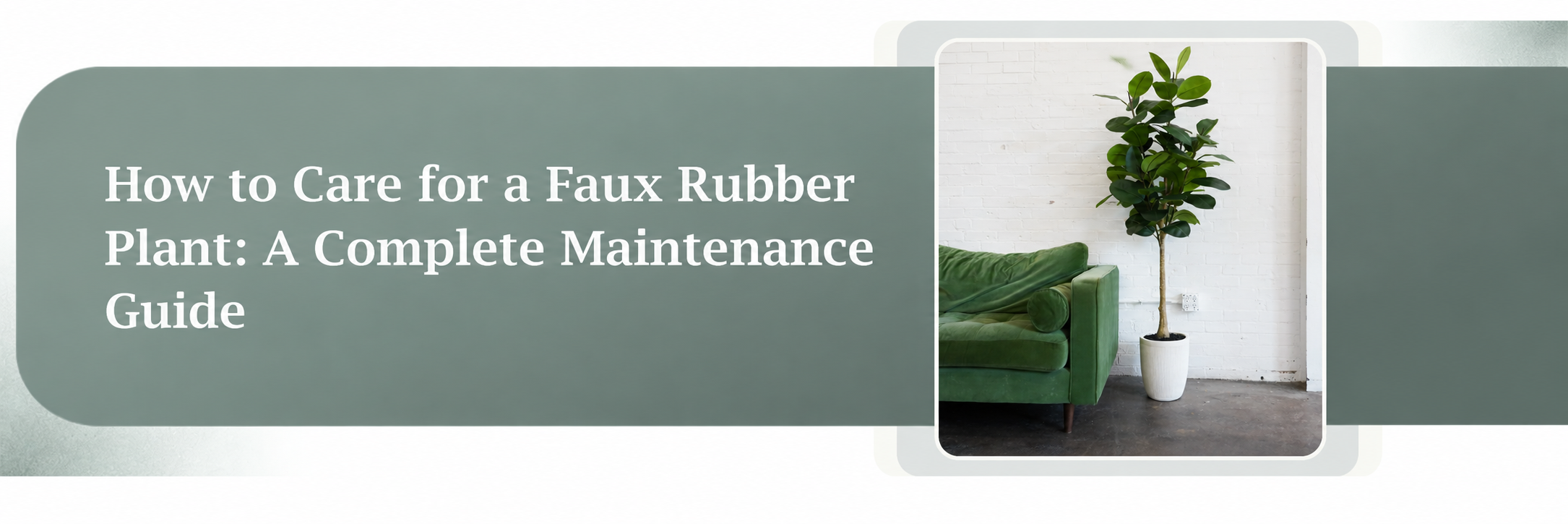
How to Care for a Faux Rubber Plant: A Complete Maintenance Guide
A faux rubber plant requires almost none of the care its real counterpart demands. No watering, no sunlight, no fertilizing, no pest checks, no pruning. The only real maintenance is periodic dusting, smart placement away from harsh UV, and occasional fluffing to keep the leaves looking natural. If you have been searching for low-effort statement greenery, the 6ft Faux Rubber Tree in White Pot from fakeflowers.com is built for exactly this kind of effortless decor.
What Is a Faux Rubber Plant?
A faux rubber plant is a lifelike artificial replica of the Ficus elastica, the popular Southeast Asian tropical houseplant known for its broad, glossy, deep green leaves and tall, sculptural trunk. The real Ficus elastica earned its name from the milky latex sap inside its veins. The faux version captures the same dramatic visual presence using soft-touch polyurethane or coated polyester leaves, wired with internal stems for shape control, and set into a cement-weighted base or decorative pot.
Modern faux rubber trees are crafted to mimic every detail of the real plant: the deep emerald color of the leaves, the subtle wax-like sheen on the surface, the burgundy underside on certain varieties, and the textured, woody trunk. Premium models go further, with hand-painted leaf veins and slight color variation between individual leaves to avoid the uniform plastic look that gives cheap fakes away.
The easiest way to identify a high-quality faux rubber plant is to feel the leaves. Soft, slightly flexible, and warm to the touch indicates premium materials. Stiff, glossy, or rubbery leaves indicate lower-cost plastic construction. Look for handcrafted finishing on the planter and visible texture on the trunk as additional quality signals.
Why People Choose a Faux Rubber Plant Over the Real Thing
Real Ficus elastica is one of the easier houseplants to keep alive, but easier is not the same as effortless. A real rubber plant still needs bright indirect light, weekly soil moisture checks, occasional fertilizer during the growing season, periodic repotting as it grows tall and root-bound, leaf dusting to maintain photosynthesis, and active monitoring for spider mites, mealybugs, and scale insects. The latex sap inside the leaves and stems is also toxic to dogs, cats, and humans if ingested, and can cause skin irritation on contact.
A faux rubber plant removes every single one of those concerns. For most buyers, the choice comes down to one of these scenarios:
- The renter or apartment dweller. Apartments with poor light expose real Ficus elastica to leaf drop, leggy stems, and slow decline. A faux rubber tree thrives in any light condition, including dim hallways and windowless corners.
- The pet owner. Real rubber plant sap is dangerous to cats and dogs. Faux is non-toxic by construction.
- The person with plant-parent burnout. Those who have killed one too many real Ficus and want the visual without the guilt cycle.
- The vacation home or office decorator. Spaces that sit empty for weeks at a time cannot sustain real plants. Faux holds its appearance through any absence.
For each of these buyers, the math is simple. The faux rubber plant delivers the look and removes the labor. For more guidance on choosing the right artificial tree for your space, see our roundup of the best large artificial trees for indoor use.
The Real Care Routine: What a Faux Rubber Plant Actually Needs
The good news: the entire faux rubber plant care routine fits on the back of a coaster.
- Dust the leaves once a month using a microfiber cloth, feather duster, or soft-bristle paintbrush
- Twice a year, do a deeper clean to remove built-up grime
- Position the plant away from direct, intense sunlight to prevent UV-driven fading
- Every six months, gently reshape the leaves and branches to prevent any settled, flattened look
- Inspect the planter base once or twice a year and add weight if the plant has started to lean
- Replace the plant when the leaves can no longer be cleaned to your standard, typically after 5 to 10 years of indoor use
That is the entire list. No watering. No fertilizing. No pruning. No pests. No repotting except for cosmetic planter swaps if you decide to upgrade the pot. For more general guidance applicable to all faux greenery, our general artificial plant care guide covers core principles in detail.
The cleaning portion of the routine is where readers benefit from a step-by-step walkthrough, which is the next section.
How to Clean a Faux Rubber Plant: A Step-by-Step Guide
The waxy, broad leaves of a faux rubber plant collect dust faster than smaller-leaf faux greenery like ferns or pampas grass. The good news is that cleaning is straightforward and quick. Here is the recommended sequence.
Step 1: Gather your supplies
You will need a microfiber cloth, a soft-bristle paintbrush (an unused 1-inch craft brush works perfectly), a feather duster for routine dusting, and an old bedsheet or drop cloth to catch falling dust. For deeper cleaning, also keep a hairdryer with a cool setting on hand. Avoid harsh chemicals, leaf shine spray, dishwashers, full immersion in water, and any abrasive sponge.
Step 2: Dust the leaves dry first
Always start with dry dusting, working from the top of the tree downward so falling dust lands on areas not yet cleaned. Use the feather duster for routine maintenance, or the soft-bristle paintbrush for deeper crevices and the underside of leaves where dust tends to compact.
Step 3: Use compressed air or a cool hairdryer for hard-to-reach spots
Holding a hairdryer set to its coolest setting about a foot from the leaves blows out dust trapped between branches and at leaf joints. Do this outside or over a drop cloth, because dust will scatter widely.
Step 4: Spot-clean stubborn marks with a damp microfiber cloth
For dirt or stains that dry dusting misses, lightly dampen a microfiber cloth with plain cool water and gently wipe each leaf, supporting the leaf from underneath with your other hand. Test colorfastness on a hidden leaf first.
Step 5: Reshape and fluff after cleaning
Faux rubber plant leaves can flatten or droop slightly after handling. Gently bend each leaf back into its natural angle and reposition any branches that shifted. The plant should look fuller and more dynamic than before you started.
Step 6: Dust the planter and surrounding floor
Most of the dust ends up at the base. A quick wipe of the planter rim and a vacuum of the floor finishes the job.
Frequency: light dusting once a month, deeper cleaning every six months. Plants placed near windows or HVAC vents may need more frequent attention.
Faux Rubber Plant Placement: Light, Sunlight, and the UV Fade Question
This is the section that makes this guide different from every real-rubber-plant care article on the internet. Real Ficus elastica needs bright, indirect light. Without it, the plant drops leaves and grows leggy. Faux rubber plants have the opposite problem: they need almost no light, and direct, intense sunlight is the single biggest threat to their longevity.
UV light is what causes faux plants to fade. Over months and years of direct exposure, the green pigments in synthetic leaves break down, leaving them washed-out, slightly grey, or yellowed. The waxy coating that gives a quality faux rubber plant its realistic sheen can also dull or develop a chalky residue under prolonged UV exposure.
The good news is that UV fading is preventable. Here is where to place a faux rubber plant for maximum lifespan.
Best placements
- Dim hallways or entryways where real plants would die
- Corners of living rooms more than 6 feet from a window
- Bedrooms with curtains typically drawn during the day
- Bathrooms, basements, or stairwells
- Vacation homes that sit empty for weeks
- Office cubicles and conference rooms
Acceptable placements
- Within 4 to 6 feet of a north-facing window
- Within 4 to 6 feet of any window with sheer curtains permanently drawn
- Inside rooms that receive only morning sun
Avoid these placements
- Direct south-facing or west-facing window placement
- Sunrooms, conservatories, or three-season porches
- Outdoor placement in summer sun
- Right next to or under intense lamp lighting (LED is generally fine; older incandescent and halogen lamps running for hours per day can heat-stress the leaves and adhesives)
If a faux rubber plant has already started to fade, the fade is permanent. There is no recoloring solution that holds up to inspection. The best mitigation is rotation: turning the plant 180 degrees every two months distributes UV exposure evenly across all sides, so any fading happens uniformly instead of leaving one half noticeably lighter.

Faux vs Real Rubber Plant: A Side-by-Side Comparison
The decision between a real Ficus elastica and a faux rubber plant comes down to lifestyle priorities. The table below summarizes the practical differences after five years of ownership.
|
Factor |
Real Rubber Plant (Ficus elastica) |
Faux Rubber Plant |
Winner |
|
Watering |
Weekly soil moisture checks required |
None ever required |
Faux |
|
Light needs |
Bright indirect light required |
Any light condition |
Faux |
|
Pet and child safety |
Toxic latex sap on contact and ingestion |
Non-toxic by construction |
Faux |
|
Lifespan |
1 to 15 years (depends on care) |
5 to 10 years guaranteed appearance |
Tied |
|
Upfront cost |
$30 to $150 typical |
$150 to $300 for premium quality |
Real |
|
5-year cost (incl. care) |
$200+ with replacements and supplies |
One-time investment, no recurring spend |
Faux |
|
Air-purifying |
Yes (per NASA Clean Air Study, 1989) |
No |
Real |
|
Maintenance time |
15+ minutes per week |
5 minutes per month |
Faux |
Beyond the tally, the most overlooked factor is the cost of ownership over time. A premium faux rubber tree like the 6ft Faux Rubber Tree in White Pot is a one-time investment that holds its appearance for 5 to 10 years with minimal effort. A real Ficus elastica costs less upfront but requires recurring spending on potting mix, fertilizer, replacement pots as it grows, occasional pest treatments, and the eventual replacement when it outgrows the space or is lost to overwatering. Over five years, the math typically favors faux.
Troubleshooting Common Faux Rubber Plant Problems
Even with light maintenance, faux plants occasionally show issues. Here are the most common ones and how to fix them.
Leaning or top-heavy stems
The most common faux rubber plant complaint. Tall artificial trees can shift over time, especially if the planter is light or the base material has settled. The fix is to add weight to the planter, either by inserting a small bag of decorative river rocks, a layer of cement-filled foam, or by transferring the tree into a heavier decorative outer planter. Premium faux rubber trees ship in a handcrafted pot with built-in stability, but any faux tree that has been moved frequently may benefit from added weight.
Dust dulling
Even careful owners occasionally notice the leaves have lost their original sheen. This is usually a fine layer of dust that has built up beyond what dry dusting alone can lift. A spot-clean with a damp microfiber cloth, following the steps in the cleaning guide above, restores the original finish.
Leaf detachment
Lower-quality faux plants can shed individual leaves as adhesives age. For premium models built with mechanical attachments rather than glue, this is rare. If a leaf detaches, a small dab of clear-drying craft glue or hot glue on a low setting can secure it back into place.
UV fading
Already covered in the placement section. Prevention is the only fix; faded leaves cannot be restored to their original color.
Branches looking flat or settled
Periodic reshaping is normal. Bend each branch back into a natural curve and adjust leaf angles. Doing this every few months keeps the plant looking premium. If you need to store the plant for an extended period, see our guide to proper storage of artificial florals to prevent permanent creasing.
How to Make Your Faux Rubber Plant Look More Realistic
A few small adjustments separate a faux rubber plant that fools every visitor from one that gives itself away. The single most important factor is the planter. A premium tree in a cheap plastic nursery pot looks fake. The same tree in a handcrafted ceramic, cement, or woven planter looks designed.
Mix textures around the base. A few decorative river rocks or a layer of dried preserved moss covering the visible base of the plant blends the transition between artificial trunk and pot. Avoid leaving the bare insertion point visible.
Pair it with other decor that signals real-plant ownership. A nearby watering can, a plant mister even if unused, or a stack of horticulture books on a side table all create a context that implies care, which subconsciously reads as authentic.
Vary the leaf angles. Most faux rubber plants ship with leaves in a slightly uniform position from packaging. Spend two minutes after unboxing gently bending each leaf into a slightly different angle and curve. Real leaves are never identical.
Keep it clean. A dusty faux plant always reads as fake. A clean, freshly dusted one rarely does.
Featured Product: The 6ft Faux Rubber Tree
For decorators ready to add a faux rubber plant to a living room, office, or entryway, the 6ft Faux Rubber Tree in White Pot is fakeflowers.com's premium offering in this category. At a full 6 feet tall, it works as a floor-standing statement piece in rooms with 8 to 10-foot ceilings. The leaves are soft-touch construction with hand-detailed coloring that captures the depth and sheen of real Ficus elastica foliage. The planter is a handcrafted white pot designed for stability, no additional weighting required.
Customers consistently report that the tree exceeds their expectations on first sight, with multiple reviewers noting it looks better than other fake plants priced significantly higher.
For a broader selection of statement greenery, explore our full artificial trees collection or shop more faux floor plants for adjacent options including faux fiddle leaf, olive, palm, and monstera.
Frequently Asked Questions
A faux rubber plant is a lifelike artificial replica of the Ficus elastica houseplant. Premium versions use soft-touch polyurethane or coated polyester leaves attached to internally wired stems set in a decorative weighted planter. The result captures the dramatic visual presence of a real rubber tree without watering, light, or upkeep requirements.
A real rubber plant (Ficus elastica) is a living tropical tree that needs bright indirect light, weekly soil moisture checks, fertilizing, and pest monitoring. The latex sap is toxic to pets and humans. A faux rubber plant needs only periodic dusting, requires no light, is non-toxic, and lasts 5 to 10 years without changing in appearance.
Clean a faux rubber plant by dusting from top to bottom with a microfiber cloth or feather duster monthly. For deeper cleaning, use a cool hairdryer to blow out trapped dust between leaves, then spot-clean stubborn marks with a damp cloth. Avoid harsh chemicals, leaf shine sprays, and full immersion in water.
A faux rubber plant never needs watering. The leaves and stems are made from synthetic materials that require no moisture to maintain their appearance. Watering or misting can actually damage the plant by causing color bleeding, adhesive failure, or water spots on the leaves. Skip watering completely and dust the leaves instead.
Faux rubber plants thrive in any lighting condition, including completely dark hallways, windowless rooms, basements, and dim corners where real plants would not survive. In fact, low-light placement is ideal because it prevents UV-driven fading. The plant requires no light to maintain its appearance and can be placed wherever décor calls for it.
Yes, faux rubber plants are safe for pets. Unlike real Ficus elastica, which contains toxic latex sap that can cause skin irritation and is harmful to dogs and cats if ingested, faux rubber plants are made from non-toxic synthetic materials. They are an excellent option for households with cats, dogs, or curious children.
Faux rubber plants designed for indoor use can be placed outside short-term on covered porches or shaded patios, but should not be left in direct sunlight or harsh weather. Standard indoor models lack the UV-stable coatings of dedicated outdoor faux plants. For permanent outdoor placement, choose a faux plant specifically rated for outdoor use.
A premium faux rubber plant lasts 5 to 10 years of indoor use without noticeable change in appearance, provided it is kept out of direct sunlight, dusted regularly, and reshaped occasionally. Lower-quality models may show fading or leaf detachment within 1 to 2 years. Investing in a higher-quality faux rubber tree pays back over time.
Conclusion
A faux rubber plant offers the dramatic look of a real Ficus elastica without the watering, the light requirements, the toxicity concerns, or the constant attention. The care routine fits on a coaster: dust monthly, place out of intense sunlight, reshape every few months, and enjoy. For decorators tired of plant-parent burnout, renters with poor light, pet owners, vacation home decorators, or anyone who wants effortless greenery, the math is simple.
For premium statement greenery built for exactly this kind of low-effort, high-impact decor, browse the 6ft faux rubber tree in white pot from fakeflowers.com. With over 25 years of experience in the artificial floral and greenery industry, fakeflowers.com builds faux pieces that hold up to the closest inspection.


