

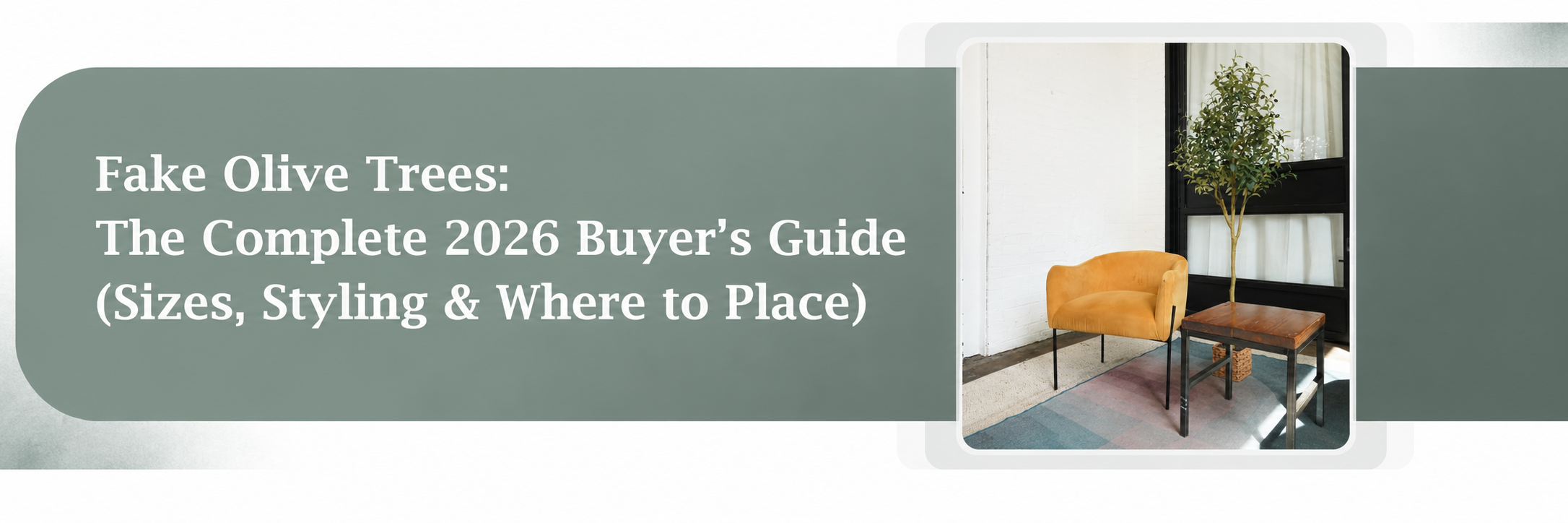
Fake Olive Trees: The Complete 2026 Buyer's Guide (Sizes, Styling & Where to Place)
Choosing the right fake olive tree comes down to four decisions: size (matched to ceiling height and floor space), trunk material (natural wood is most realistic), placement (sunny corners suit them best visually, but they don't need real light), and styling (a proportional pot and branch fluffing transform any tree). This guide walks through each, with size-to-placement mapping and honest material breakdowns.
Why Fake Olive Trees Are Everywhere in 2026
Walk into any newly-renovated home, modern boutique, or design-forward restaurant in 2026 and you'll probably see one: a tall, sculptural olive tree, branches spreading wide, silvery-green leaves catching the light. Olive trees became the defining indoor plant of the late 2020s for a clear reason — they evoke Mediterranean warmth and modern-farmhouse calm in equal measure, work with almost any color palette, and bring height into a room without crowding the floor.
Here's the catch: real olive trees are notoriously difficult to keep alive indoors. They need full direct sun (six-plus hours daily), specific watering rhythms, and they sulk when humidity drops in winter. Most live olive trees bought online for indoor use die within 18 months. That's why faux olive trees have become the actual solution — the look, without the funeral.
But not all fake olive trees are created equal. The gap between a $60 wire-and-plastic tree that screams "craft store" and a $400 tree people genuinely mistake for real is enormous. This guide walks through what separates them, what size you actually need, where to place it, and how to style it. When you're ready, our artificial tree collection is organized by size so you can filter directly to the height range that fits your space.
The 5 Things That Make a Fake Olive Tree Look Real
-
PE (polyethylene) leaves with silvery-green color variation. Real olive leaves have a distinctive matte, slightly waxy character — darker green on top, silvery-pale underneath. The most realistic fake olive trees use PE (polyethylene) leaves with two-tone color and individually shaped foliage. Silk or printed polyester leaves look flat and uniform — they're an immediate giveaway.
-
A natural wood trunk. Trunk choice is the single biggest realism factor. Premium fake olive trees use real preserved wood — usually an actual olive or similar branch, treated and grafted with synthetic foliage. Mid-tier trees use molded resin or composite painted to look like bark; these are good at a distance but show repetitive patterns up close. Cheap trees use wire wrapped in floral tape — instantly recognizable as fake.
-
Branch density and natural spread. Real olive trees have hundreds of small branches with leaves clustered at the tips. Realistic fakes match this: many thin branches at varied angles, leaves dispersed along the length and concentrated at the ends. Thinly-leaved trees with bare branches in the middle read as fake — and as cheap.
-
Asymmetry and lean. Real olive trees don't grow as perfect spheres. They lean slightly, with branches longer on one side than the other, and the canopy is wider than tall in mature trees. The best fakes mirror this — they have a deliberate lean, an asymmetric canopy, and look like they grew that way. Perfectly symmetric trees always read as artificial.
-
Bendable, hand-shapeable branches. Quality fake olive trees arrive with wire-core branches that you can bend into a final shape. This isn't optional — every tree needs 15-20 minutes of unboxing and shaping to look right. Trees with rigid, unbendable branches will always look like the day they came out of the box, which is usually the most compressed and unnatural state.
Fake Olive Tree Size Guide: Matching Height to Placement
The most common olive tree buying mistake is wrong size. A 4-foot tree disappears in a tall-ceiling living room; a 7-foot tree overwhelms a small bedroom. Use ceiling height as the constraint and floor footprint as the secondary check.
Quick rule: leave 18-24 inches of clearance between the top of the tree and the ceiling. For an 8-foot ceiling, max tree height is around 6-6.5 feet. For a 9-foot ceiling, you can go up to 7-7.5 feet. For 10-foot ceilings, you have room for an 8-foot statement tree.
|
Tree Size |
Ceiling Height |
Best Placement |
Pot Type |
Price Range |
Best For |
|---|---|---|---|---|---|
|
Tabletop (under 3ft) |
Any |
Desk, console table, shelf, kitchen counter, bathroom vanity |
Small ceramic or terracotta pot, 4-8" diameter |
$40-120 |
Adding greenery without floor space; rentals or small spaces |
|
4ft |
8ft+ |
Beside a sofa, narrow corner, home office, bedroom corner |
Mid-size ceramic or woven basket, 10-12" diameter |
$120-250 |
First-time olive tree buyers; smaller rooms |
|
5ft |
8ft+ |
Living room corner, fireplace flank, entryway console accent |
Medium ceramic, stoneware, or large woven basket, 12-14" |
$180-350 |
Most common size — works in most rooms |
|
6ft |
9ft+ |
Living room corner, behind a sofa, dining room corner, large entryway |
Large ceramic, stoneware, terracotta or concrete planter, 14-18" |
$250-500 |
Statement tree in average-ceiling rooms |
|
7ft |
9-10ft+ |
Open-plan living rooms, two-story foyer, restaurant/commercial spaces |
Large concrete or stoneware planter, 16-20" |
$350-700 |
Statement tree, vaulted-ceiling rooms |
|
8-10ft |
10ft+ / vaulted |
Two-story entryways, commercial lobbies, retail showrooms |
Substantial floor planter, 20"+ |
$600-1,500+ |
Architectural statement only — needs the room to handle it |
How to size your room before you buy
- Measure your ceiling height in feet. Subtract 18 inches (1.5 feet) for clearance.
- Measure the floor footprint where the tree will sit. Most olive trees have a 30-48 inch canopy spread — make sure the spread fits without the tree touching walls or furniture.
- Stand a piece of cardboard or a broom at your chosen height. Walk past it from typical sight lines. If it feels too big, drop a size. If it feels small, go up.
- Account for the pot. Most fake olive trees are sold without a decorative pot, or with a basic plastic insert. Add 8-14 inches of pot height to the tree height to get the total displayed size.
- If you're between two sizes, go larger. Olive trees that are too small look like an afterthought. Trees that are slightly too large feel intentional.
Trunk Materials: The Honest Breakdown
Trunk material is where price tiers separate. Two trees with similar leaves can cost $150 apart entirely because of the trunk. Here's what you're actually choosing between.
|
Trunk Type |
What It Actually Is |
Visual Realism |
Touch |
Lifespan |
Price Tier |
|---|---|---|---|---|---|
|
Natural Wood (Preserved) |
Real olive (or similar) wood branch, dried and treated, grafted with synthetic foliage |
Excellent — true bark texture, natural irregularity, no repeating patterns |
Authentic — feels like wood |
10+ years indoors |
Premium ($$$-$$$$) |
|
Resin-Cast Composite |
Molded resin or polymer cast to look like olive bark, hand-painted |
Good at 4+ ft distance; up close, the cast pattern repeats |
Smooth, slightly cool — clearly not wood |
5-8 years indoors |
Mid ($$-$$$) |
|
Wire + Floral Tape Wrap |
Steel wire core wrapped in textured fabric tape, sometimes with foam padding |
Acceptable for trees under 4ft; obvious in larger trees where the wrap shows seams |
Soft, gives under pressure |
3-5 years indoors |
Budget ($-$$) |
|
Dual or Multi-Trunk Designs |
Two or three trunks (often natural wood) joined at the base — mimics mature olive trees grown in clumps |
Excellent — adds visual interest and authenticity |
Wood feel |
10+ years indoors |
Premium ($$$$) |
Which trunk type should you choose?
If realism matters more than budget, natural wood trunks are the answer — they're the single biggest visual upgrade you can make. The texture, irregularity, and the way they age (slight color shift toward darker honey tones) cannot be matched by composite trunks. Most premium fake olive trees in 2026 use natural wood. For deeper coverage on the technical buying criteria — leaf material quality, branch construction, finish standards — see our guide to choosing artificial olive trees.
If budget is the constraint, resin-cast composite trunks are the best mid-tier option. They look convincing at typical viewing distance (4+ feet) and the savings can be substantial — often $100-200 less than the natural wood equivalent. They're a smart choice for secondary placements (bedroom corners, home offices) where the tree isn't the focal point.
Avoid wire-wrap trunks in trees over 4 feet. The wrap pattern becomes visible, the tape may yellow over time, and the tree feels insubstantial in larger sizes. Wire-wrap is fine for small tabletop trees where you're not examining the trunk closely.
Where to Place a Fake Olive Tree: 9 Room Placements That Work
Olive trees are remarkably forgiving in placement — they don't need real light, water, or specific humidity. The constraint is visual: where will the tree's height and spread feel intentional rather than awkward? Here are nine placements that consistently work.
1. Entryway / Foyer
A 6-7 foot olive tree in an entryway makes the strongest first impression of any single home decor decision. Place it to the side of the front door or next to a console table. Two-story entryways can handle 8-10 foot trees. Pair with a stoneware or concrete planter for an architectural look, or a terracotta pot for warmer Mediterranean styling.
2. Living Room Corner
The single most common placement. A 5-6 foot tree in a corner (between a sofa and wall, or between two windows) fills empty vertical space without crowding the seating. Avoid placing directly in the path between sofa and entry — the spread will be in the way. A woven basket or large ceramic pot suits this placement best.
3. Flanking a Fireplace
A pair of matched 4-5 foot olive trees flanking a fireplace is a classic styling move — it adds symmetry without competing with the mantle. Match the pots exactly. If you only want one tree, place it on the side opposite a heavily-decorated mantle or built-in for balance.
4. Behind or Beside a Sofa
A 5-6 foot tree placed behind a sofa (against the wall) softens the geometric edges of upholstered furniture and adds vertical interest. The tree should be tall enough that its canopy clears the top of the sofa back — otherwise it disappears.
5. Home Office
A 4-5 foot tree in a home office corner adds natural texture without competing with monitors or desk surfaces. This is also the placement that benefits most from natural-wood trunks — you'll be sitting near it and looking at it often, so realism matters.
6. Bedroom Corner
Olive trees work beautifully in bedrooms because they don't trigger allergies, attract bugs, or require care. A 4-5 foot tree in a corner opposite the bed adds height and softens the room. Avoid placing immediately next to the bed — the spread can feel crowding when you're lying down.
7. Kitchen — Banquette or Breakfast Nook
A small 3-4 foot olive tree in a corner of a breakfast nook or near a banquette adds the Mediterranean note olive trees evoke. Avoid placing directly above or next to cooking surfaces — heat and oil splatter will degrade the leaves over time.
8. Bathroom
Only small, 2-3 foot tabletop olive trees here, and only in well-ventilated bathrooms with windows. Persistent humidity can warp natural-wood trunks over years. A bathroom is one of the only places where a resin-composite trunk is actually preferable — moisture-stable.
9. Covered Patio or Outdoor Porch
UV-treated fake olive trees can be used on covered patios — verandas, screened porches, covered patios with overhangs. They cannot be used in full direct sun without significant fading. Even "UV-treated" or "UV-resistant" trees will show noticeable color shift after 1-3 years of direct sunlight. For outdoor placement, see our artificial tree buying guide for the durability breakdown.
Indoor vs Outdoor: The Honest UV Reality
Faux olive tree marketing is full of "UV-resistant" and "weatherproof" claims that overpromise. Here's the actual truth:
- Indoor placement: Almost all quality fake olive trees last 10+ years indoors with no special care beyond monthly dusting. Color stays true, leaves don't shed (unless physically damaged), trunks don't warp.
- Covered outdoor placement (porch, veranda, lanai): UV-treated trees can last 3-5 years before noticeable fading. Direct sun for 2-4 hours per day is the practical limit before color shift accelerates.
- Full direct-sun outdoor placement: Not recommended for any fake olive tree. Even premium UV-treated trees will show significant fading within 12-18 months in direct sun. Choose a real olive tree (in suitable climates) or accept seasonal replacement of the fake.
"UV-resistant" is not "UV-proof." Any product that claims complete UV immunity is overstating. Treat UV ratings as relative protection (slows fading), not absolute (prevents it).
What Should a Quality Fake Olive Tree Cost?
Pricing for fake olive trees breaks into three clear tiers. Understanding what you're paying for at each price point prevents both underbuying (something that looks cheap) and overbuying (paying premium tier prices for mid-tier construction).
Budget tier: $50-150
Trees in this range typically have wire-wrapped trunks, polyester or low-grade PE leaves, and shorter heights (under 4 feet). They work for tabletop placements, rental properties, and situations where you need the visual category without close inspection. Lifespan is typically 3-5 years.
Mid tier: $150-400
This is the sweet spot for most buyers. Trees in this range use either premium PE leaves with resin-composite trunks, or PE leaves with budget natural-wood trunks. Heights range from 4-6 feet. The leaves will look convincing, the trunk acceptable at viewing distance, and lifespan extends to 7-10 years.
Premium tier: $400-$1,500+
Premium fake olive trees use natural-wood trunks (often from actual preserved olive or similar branches), hand-shaped PE leaves with multi-tone color, and substantial heights (6-10 feet). They're the ones interior designers specify when they need a tree that passes close inspection. Lifespan is 10+ years and most retain resale value.
Where to spend the budget if you have to choose: trunk material first, leaf quality second, size third. A 5-foot tree with a natural wood trunk will look more realistic than a 7-foot tree with a wire-wrapped one.
Common Styling Mistakes That Make Fake Olive Trees Look Fake
This is the section most other guides skip. Even a premium $400 olive tree can look obviously fake if you make the wrong styling moves. Most fixes are free.
Mistake 1: The wrong pot
Fake olive trees almost always ship in a basic plastic insert. Leaving them in that is the single fastest way to make a quality tree look cheap. Move them into a substantial ceramic, stoneware, terracotta, woven, or concrete planter that's proportional to the tree (pot width roughly 1/3 to 1/2 the tree's canopy width). The pot is half the visual cost — don't skimp.
Mistake 2: Not fluffing the branches
Fake olive trees arrive compressed for shipping. Branches are tied or folded against the trunk. Plan 15-20 minutes of unboxing to bend each branch outward, separate clustered leaves with your fingers, and shape the canopy so it spreads naturally and asymmetrically. Skipping this step is the most common reason "fake-looking" trees actually look fake — they're fine trees, undershaped.
Mistake 3: Perfect symmetry
After fluffing, deliberately make the tree asymmetric. Real olive trees lean, have one side longer than the other, and have varied canopy density. A perfectly round, symmetric fake olive tree always reads as artificial. Pull a few branches forward, push a few back, and tilt the trunk slightly if the pot allows.
Mistake 4: Wrong lighting
Olive trees photograph and display best in indirect natural light or warm overhead lighting. Cool fluorescents or harsh overhead spotlights flatten the leaves and emphasize the synthetic material. Place fake olive trees near a window (they don't need the light — you need it for visual realism), or under warm-temperature LEDs (2700-3000K).
Mistake 5: Mismatched scale
A 7-foot olive tree in a small studio apartment looks comical. A 3-foot tree in a two-story foyer looks lost. Scale to the room — most placement mistakes are scale mistakes. If you're between sizes, go larger; small fake trees almost always look out of place, while slightly oversized ones feel intentional.
Mistake 6: Visible plastic at the base
If the plastic insert pot is smaller than the decorative outer pot, you'll see plastic showing at the top. Fill the gap with sheet moss, decorative stones, or natural-looking filler. This is the difference between a tree that looks finished and one that looks halfway-styled.
Mistake 7: Skipping the dust check
After six months, every fake olive tree accumulates a film of dust that dulls the leaf color from silver-green to gray-green. A soft duster or a quick blast with a hairdryer on cool setting once a month is enough. Our artificial plant care guide covers deeper cleaning for trees that have gone too long without.
Mistake 8: Buying the wrong shape for the placement
Olive trees come in two general shapes: wide-spreading (canopy wider than tall) and tall-narrow (taller than wide). Wide-spreading trees suit corners with open space around them. Tall-narrow trees suit tight spots — between a sofa and wall, beside a fireplace, in a narrow entryway. Buying the wrong shape for the space means either crowding or empty space.
Featured Olive Trees by Size
These represent each size tier from our collection. Pick by the placement you're trying to fill — exact dimensions and material details are on each product page.
- Desktop Olive Tree (2.5ft) — tabletop or counter placement; ideal for kitchens, bathrooms, or smaller spaces
- 4ft Faux Olive Tree in Woven Basket — first-time olive tree buyers; bedroom corners and home offices
- 5ft Olive Tree — the most versatile size; living room corners and fireplace flanks
- 6ft Olive Tree in Plastic Pot — statement size for standard-ceiling rooms; pair with a substantial decorative planter
- 7ft Olive Tree (Natural Wood Trunk) — premium tier; open-plan living rooms and vaulted-ceiling spaces
- Dual-Trunk Olive Tree (6.5ft) — multi-trunk realism for design-forward placements
Browsing the full set is fastest on the artificial trees collection page — filter by size to narrow to what fits your space.
Why We Know This
FakeFlowers has been curating and selling faux florals and trees for 25 years. In that time we've watched fake olive trees go from clearly-artificial wire-and-plastic constructions to natural-wood-trunked pieces that get specified by interior designers. Our buying team vets every olive tree in the collection against the standards in this guide — leaf material, trunk realism, branch construction, and finish. Trees that don't pass don't make it onto the site. You can read more about our standards and history.
FAQs
Match tree height to ceiling height with 18-24 inches of clearance. For 8-foot ceilings, choose a tree 5-6.5 feet tall. For 9-foot ceilings, 6-7.5 feet works well. For 10-foot or vaulted ceilings, 7-8 feet is the right scale. Tabletop trees (under 3 feet) suit any ceiling but only as accent pieces.
Yes — fake olive trees are one of the most enduring interior design trends of the late 2020s. Their Mediterranean character works with modern farmhouse, Scandinavian, minimalist, and contemporary styles equally. Searches for the term have grown more than 25% year-over-year, and they continue to appear in design magazines, hotels, and high-end residential projects.
Four signals: a natural wood trunk (not wire-wrapped or molded plastic), PE polyethylene leaves with silvery-green two-tone color variation, branch density with leaves clustered at branch tips, and asymmetric canopy spread. Price is also a reliable signal — quality olive trees over 5 feet typically start around $200 and go up to $700+ for premium pieces.
Only UV-treated trees, and only in covered outdoor spaces (porches, verandas, screened patios). Even UV-treated trees fade noticeably in full direct sunlight within 12-18 months. For covered placement with limited direct sun, expect 3-5 years of color stability. Standard indoor fake olive trees should not be placed outdoors at all.
Indoors with monthly dusting, quality fake olive trees last 10+ years with color and structure intact. Budget trees ($50-150 range) typically last 3-5 years before leaves shed, color dulls, or wrap materials degrade. Mid-tier trees ($150-400) last 7-10 years. Outdoor placement reduces lifespan substantially even with UV treatment.
The most successful placements are: living room corners (5-6ft tree), entryway or foyer (6-7ft for impact), flanking a fireplace (matched 4-5ft pair), behind or beside a sofa (5-6ft), home office corner (4-5ft), bedroom corner (4-5ft), and breakfast nooks (3-4ft tabletop). Avoid placing directly above heat sources or in unventilated bathrooms.
Premium fake olive trees with natural-wood trunks and PE leaves are difficult to distinguish from real olive trees at typical viewing distance (4+ feet), and many pass close inspection. Mid-tier trees look convincing in styled settings. Budget trees with wire-wrapped trunks are clearly identifiable as fake regardless of styling. Trunk material is the biggest single realism factor.
Budget tier ($50-150) covers tabletop sizes and basic construction; mid tier ($150-400) is the sweet spot for 4-6 foot trees with quality leaves and acceptable trunks; premium tier ($400-1,500+) gets natural-wood trunks, larger sizes, and dual-trunk designs. Going below $50 almost always means a tree that looks cheap. Going above $1,500 reflects size and design rarity.
Putting It Together
Choosing the right fake olive tree comes down to matching size to ceiling height, picking a trunk material that fits your budget and realism standards, placing it where the spread and height feel intentional, and styling it (the pot, the fluffing, the asymmetry) so it doesn't read as straight-out-of-the-box. None of these decisions are difficult, but skipping any one of them is what separates a tree that looks expensive from one that looks like an afterthought.
When you're ready to browse, explore our artificial trees collection — filter by size to find what fits your space, or send our team a photo of the room you're styling and we'll suggest the height and trunk type that works best.


