

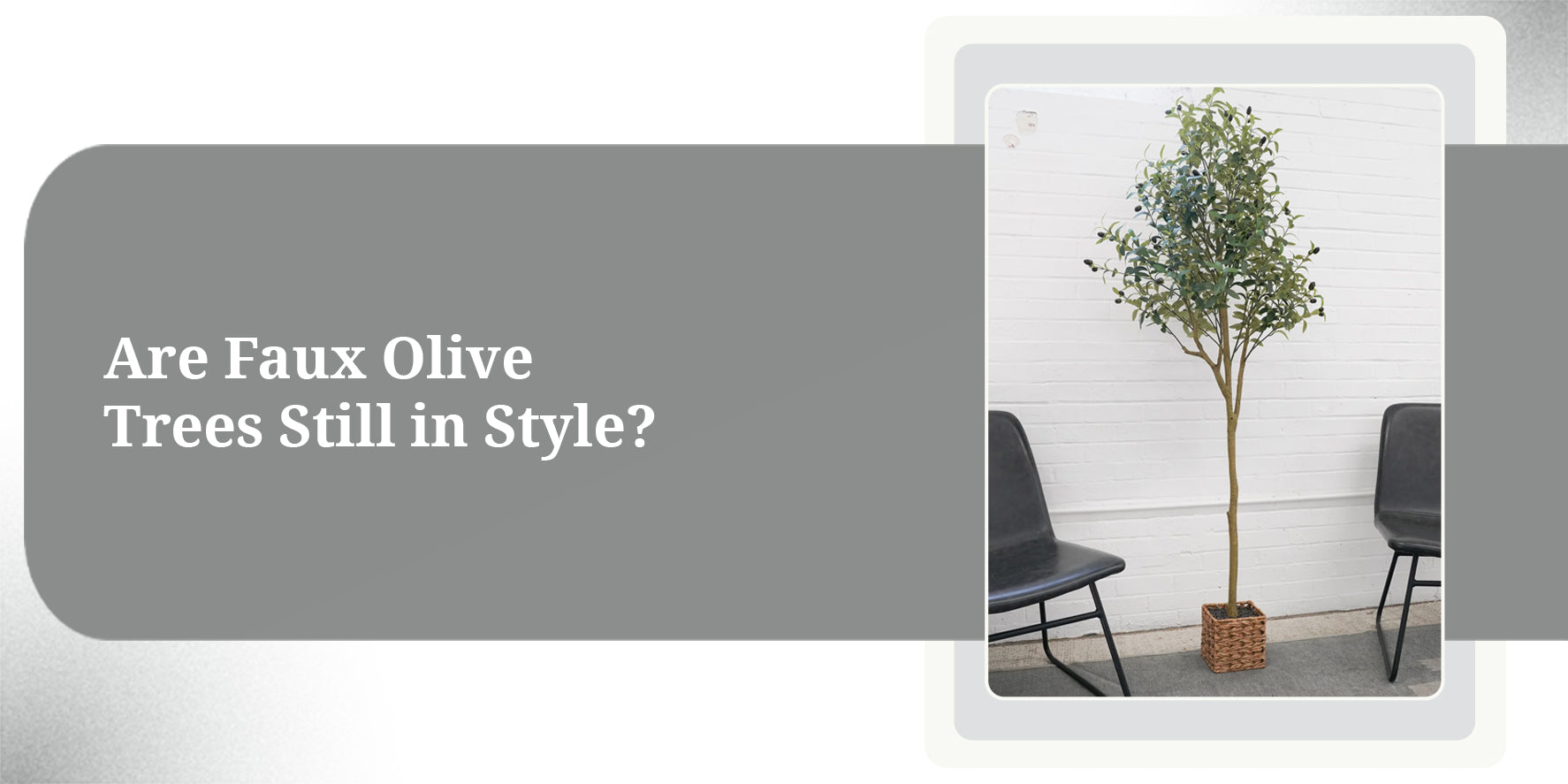
Are Faux Olive Trees Still in Style?
Short answer: Yes, faux olive trees are still in style. While some artificial plants have fallen out of favor, realistic faux olive trees remain a favorite among interior designers because they add organic shape and year-round greenery without the maintenance.
If you're wondering whether your olive tree (or the one you're about to buy) will look current a year from now, the honest answer depends less on the plant itself and more on the quality of the piece and how you style it. Here's what's actually happening with this design staple, and how to make sure yours reads as intentional rather than dated.
What Made the Faux Olive Tree So Popular in the First Place?
Before addressing whether the trend has staying power, it helps to understand why homeowners and designers reached for the olive tree over other statement plants in the first place.
For years, the fiddle-leaf fig was the plant every design-forward home seemed to have. It looked striking in photos but was famously difficult to keep alive; brown leaf edges, dropped foliage, and constant repositioning were part of the deal even with a real one. A fake olive tree solved that problem while introducing a softer, quieter look. Its slender, silvery-green leaves and gently gnarled trunk read as relaxed and grounded rather than dramatic, which fits the calmer, more textural direction home design has taken.
An olive tree faux piece also does something practical that real plants can't: it holds its shape and color regardless of sunlight, watering schedule, or how often you remember to rotate it. For renters, offices, and anyone without reliable natural light, that's a meaningful advantage.
Are Faux Olive Trees Out of Style in 2026?
No. What you're likely picking up on is a bit of "trend fatigue" chatter, the kind of hot take that shows up whenever something becomes common enough to appear in nearly every staged listing, café corner, and Instagram feed. That's not the same as a design element actually falling out of favor.
Here's the distinction worth understanding:
|
What people mean by "out of style" |
What's actually true |
|
"Everyone has one, so it feels overdone" |
Ubiquity isn't the same as being dated; it means the design earned staying power |
|
"The cheap, thin version looks fake" |
Correct, but that's a quality issue, not a style issue |
|
"It was a 2020s trend that will fade" |
Search volume and designer usage are both still climbing, not shrinking |
|
"Minimalist rooms are moving to something else" |
Olive trees fit minimalist, coastal, Scandinavian, and traditional styles equally well, which is part of why they've lasted |
The trees that do look tired are usually the sparse, single-stem versions in a plain white plastic nursery pot, left unstyled in an empty corner. That's a styling and quality problem you can fix, not a reason to skip the olive tree altogether.
How Do You Tell a Dated Faux Olive Tree From a Timeless One?
The quality of the tree, not the idea of a faux olive tree itself, determines whether it looks timeless or outdated. Here are the key features to look for:
- Realistic leaves: Natural olive leaves have soft green tones with silvery-gray undertones and subtle variation. Uniform, glossy leaves tend to look artificial.
- Textured trunk: A realistic trunk should have visible grain, natural texture, and slight irregularities instead of a smooth, painted finish.
- Full, natural branching: Fuller canopies with branches at varied angles look more authentic than sparse, evenly spaced ones.
- Balanced proportions: The canopy, trunk, and planter should be proportionate to create a cohesive, realistic appearance. The best fake olive tree options are proportioned so the canopy, trunk, and container all feel like they belong together.
If you already own a tree that's looking a little flat, our guide on how to make fake plants look real walks through the material and construction details worth checking before you shop for a replacement.
How to Style a Faux Olive Tree So It Never Looks Dated
Styling does more heavy lifting than most people expect. Two identical trees can look completely different depending on placement, pot choice, and a bit of shaping.
Start with the pot, not just the tree
A drop-in plastic pot works well in modern or minimalist rooms where you want clean lines. For a more textured, collected look, a woven basket instantly warms the piece up and fits farmhouse, coastal, or traditional interiors. If your tree's stock pot feels a little plain, slide it into a decorative planter instead of replacing the whole piece.
Shape the branches before you place it
Straight out of the box, branches are often packed close together for shipping. Gently bend and fan them outward so the canopy looks like it's grown that way naturally, rather than being assembled. This single step makes the biggest visible difference in realism.
Give it a "job" in the room
A styled tree looks intentional; an unstyled one looks like filler. Use your olive tree to:
- Anchor an empty corner near a window or reading chair
- Flank a doorway or fireplace in a pair for symmetry
- Act as a soft room divider between a living and dining space
- Frame a piece of furniture, like a credenza or sofa, to add height
Layer it with other textures
Pair the tree with a woven rug, ceramic vases, or a stack of books at its base. A single tree standing alone in an otherwise bare corner is exactly the look that reads as dated — surrounding it with a few other natural materials makes the whole vignette feel finished.
What's the Best Faux Olive Tree for Your Space?
Sizing is where a lot of people go wrong; either the tree disappears into the room or overwhelms it. As a general rule:
|
Room size/use |
Recommended height |
Notes |
|
Desk, shelf, or small tabletop |
2–3 ft |
Best for offices or apartments with limited floor space |
|
Standard living room corner |
5–6 ft |
Works as a subtle accent without dominating the room |
|
High ceilings, entryways, or lobbies |
7 ft+ |
Creates a dramatic focal point; pairs well in a matched set |
|
Small bedrooms |
4–6 ft |
Adds height and softness without crowding the layout |
For most homes, a 6ft option is the sweet spot, tall enough to read as a real statement piece, but not so large it needs a dedicated corner. Our 6ft Olive Tree in Woven Basket leans traditional and textural, while the 6ft Olive Tree in Plastic Pot is a cleaner, more modern base you can drop into your own planter. Both are handcrafted with the fuller branch structure and varied leaf tones that keep an olive tree looking current rather than like a mass-produced "lifelike faux tree" grabbed off a big-box shelf.
If you're comparing the full lineup, the Artificial Olive Tree Indoor collection shows both sizes side by side, or browse Artificial Trees more broadly if you're also considering a rubber tree or willow tree for a different room.
Fake Olive Tree Indoor vs. Outdoor: What to Know
Most fake potted olive tree options on the market, including ours, are designed for indoor use, meaning the materials prioritize a soft, realistic finish over weather resistance. If you want one for a covered patio or porch, look specifically for UV-resistant foliage, since untreated leaves will fade and go brittle with sun exposure. Keeping an outdoor piece under a roofline or awning, rather than in direct rain, will extend its life considerably either way.
For an olive tree faux piece staying indoors, you have more flexibility — near a bright window is fine, since there's no risk of the color washing out the way it can outdoors over time.
Fake Potted Olive Tree: Choosing a Container Style
The pot is doing more visual work than most people give it credit for. A quick comparison:
|
Pot style |
Best for |
Look it creates |
|
Drop-in plastic pot |
Modern, minimalist spaces |
Clean, understated, easy to swap into your own planter |
|
Woven basket |
Coastal, farmhouse, traditional |
Warm, textured, collected-over-time feel |
|
Ceramic planter |
Formal or transitional rooms |
Polished, slightly elevated |
|
Concrete or stone-look pot |
Industrial or contemporary spaces |
Grounded, architectural |
If your tree came in a basic pot and you want a quick refresh, dropping it into a new planter is often enough to make an older tree feel current again; no need to replace the whole piece.
How to Care for Your Fake Olive Tree So It Lasts
One of the advantages of a faux olive tree is that upkeep is minimal, but a little care keeps it looking sharp for years. A soft feather duster or dry cloth every couple of weeks handles routine dust, and the thin leaves don't trap much of it to begin with. A few times a year, take the tree down for a more thorough wipe, check for any bent or loose branches, and refresh the soil-look topper if it's showing wear. For a full walkthrough, our guide on how to clean and maintain your fake trees covers dusting techniques and seasonal deep-cleaning in more detail.
FAQs
No. Faux olive trees remain popular, especially high-quality, realistic designs. Sparse, low-quality versions are what tend to look dated.
Shape the branches naturally, use a stylish planter, and place it in a purposeful spot, such as a corner or beside furniture.
A 5–6 ft tree is the most versatile size for most living rooms, adding height without overwhelming the space.
Only if it's labeled as UV-resistant or outdoor-safe. Indoor trees can fade and deteriorate outdoors.
Dust it regularly, avoid prolonged direct sunlight for indoor trees, and reshape the branches occasionally to keep a natural look.
Looking for a faux olive tree that's built to last rather than fade out of style? Browse the Artificial Olive Tree Indoor collection for handcrafted options in both woven basket and plastic pot styles, or check out the wider Artificial Trees range if you're furnishing more than one corner of your home.


